"If we understand that Self, the Witness, is the Drop and that the Ocean is the Flow of Chaos, a Chaos that breathes us from the Condensed Atmosphere to the last drop, we can imagine existence as an immense ocean in motion with whirlpools and perturbations of its own flow and waves.
That ocean possesses the properties inherent to Rubedo.
Synchrony with the Whole and transit without friction but with movement.
Fluidity without resistance is, in essence, Rubedo.
And Rubedo is, in essence, the natural state of the Drop, whether or not the consciousness of the Witness is involved."
CHAOSISM:
MECHANICS OF THE FLOW
DYNAMICS OF EXPERIENCE
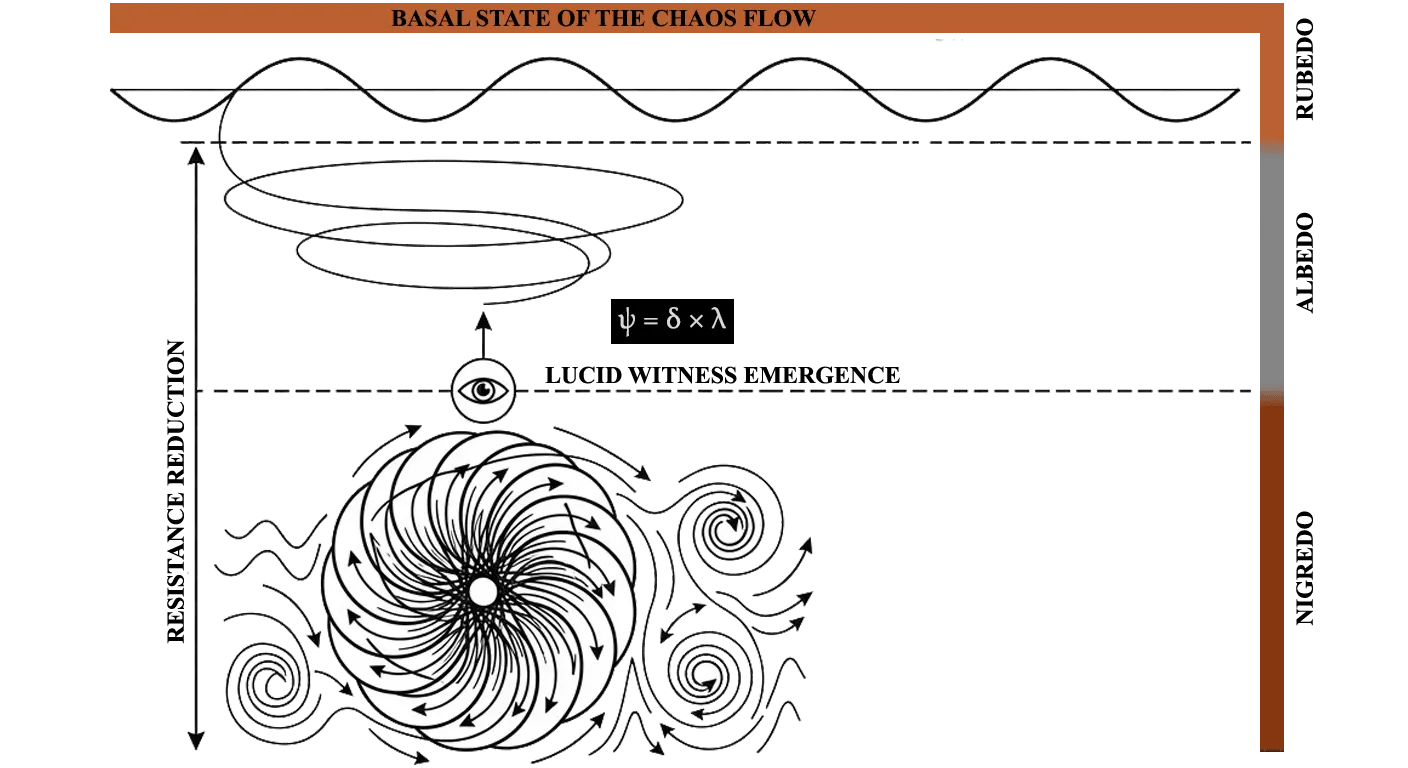
PERTURBATIONS OF THE FLOW: ASCENDING SPIRALS THROUGH 3 PHASES
Within Chaosism, Rubedo can be understood as a state of basal continuity, as a flow of experience with minimal friction. Perturbations are the modulations that temporarily interrupt this continuity.
If Rubedo is understood as the Ocean's natural state, perturbations are the waves and vortices that arise from within the field itself, momentarily disturbing that state.
They emerge from chaosistic triggers such as fear, desire, loss, conflict, or attraction. These stimuli condense experience, generating localized increases in density that activate a spiral of transit.
Every Perturbation follows a structural sequence:
it originates in Nigredo (friction and identification), may ascend into Albedo (recognition and disidentification), and dissolves upon returning to Rubedo (cessation of resistance and reintegration into the Flow, regardless of outcome).
The spiral trajectory of the Perturbation is not fixed.
Its intensity, duration, and recurrence depend on the degree of resistance generated within the system. High resistance prolongs Nigredo and densifies experience; lower resistance allows faster transit and lighter dissolution.
This process does not represent a linear evolution toward a final state. Perturbations are not anomalies of the system, but structural events within the Flow.
They function as oscillations of the Mandate:
Emergence, ascent, dissolution, and recurrence.
Through this movement, the system continuously reorganizes itself.
The Flow does not stabilize permanently.
It is rhythmically interrupted and restored.
PERTURBATIONS OF THE FLOW
Fractal spirals can be categorized with the sole and exclusive intention of studying them and establishing a pattern to measure their impact on the Basal Flow of Chaos according to three variables:
THE SPIRALS OF TRANSIT
ψ (Psi) — Perturbation capacity of the spiral
How much it alters the basal flow of Chaos.
δ (Delta) — Density of the spiral
Depth with which the event affects the Self.
How many internal layers it removes.
λ (Lambda) — Resistance / Length of the Spiral
Degree of internal friction. How many horizontal turns
are made in Nigredo before ascending.
ψ = δ × λ
HOW MUCH DOES THE EXPERIENCE
PERTURB THE FLOW?
Retrospective: Calculated after reaching Rubedo, by observing the actual duration of the transit.
Comparative: Estimated based on the history of similar perturbations or previous recurrences of the same event.
Purely Intuitive: Witnessed qualitatively by the Witness during the transit, without the need for precise measurement.
Estimated Values for Variables (δ, λ, ψ) can be:
PERTURBATION EQUATION
Low ψ indicates weak disturbance. The spiral ascends rapidly through its phases and dissolves with minimal alteration to the wider Flow.
INTERPRETATION OF THE MECHANIC OF FLOW
The Mechanics of Flow describe the degree to which Perturbation interferes with the basal continuity of experience.
High ψ indicates strong disturbance. Friction persists, Nigredo extends, and the system remains identified with Perturbation for longer durations.
The Witness does not command this process. Its role is to remain present within recurrence, allowing resistance to diminish across transit until the spiral naturally reintegrates into the Flow.
Within Chaosism, perturbations are not permanently eliminated.
As long as an event retains experiential density, its spiral may reactivate days, months, or years later.
What changes across recurrence is not the existence of Perturbation itself, but the degree of resistance with which it is traversed. A conflict that once dominated the system for weeks may later dissolve within hours.
Some perturbations appear to resolve by collapsing into Basal Rubedo without conscious integration. In such cases, the disturbance has not completed its transit but entered a suspended state.
Chaosism names this condition Latent Perturbation as unresolved friction resting beneath the Flow, capable of returning under altered forms whenever conditions reactivate it.
RECURRENCE OF PERTURBATIONS
ONEIRIC PERTURBATION
(NON-CONSCIOUS SYMBOLIC TRANSIT)
LATENT PERTURBATION
(INCOMPLETE TRANSIT)
The transit of perturbations is not limited to waking states. The system continues processing experience even when the conscious Witness is not operative.
Latent Perturbations (those whose transit has not been completed) may reactivate during rest as Oneiric Perturbations (dreams or nightmares). In this state, experience is not guided by will or lucid observation, but reorganizes autonomously within the system.
This process does not constitute a fully lucid transit, yet it may produce a partial reduction of resistance. The system continues integrating fragments of the Perturbation, allowing future recurrence in waking states to occur with less friction.
From the perspective of Chaosism, this belongs to accumulative learning:
Not all integration is conscious, but every Perturbation tends toward reorganization until its transit is completed.
The Witness does not engage in this process with lucidity.
Yet Chaos continues processing itself through it.
The system does not evolve toward a life without Perturbation, but toward a state in which spirals emerge and dissolve with increasing lightness, interfering less with the basal continuity of the Flow.
There is no final liberation.
Only recurrence crossed with greater lucidity and lower resistance.
ORBITAL PERTURBATION
(PARTIALLY OR FULLY COMPLETED OBSESSIVE TRANSIT)
Not all recurrent perturbations originate from incomplete transits.
Some perturbations maintain a persistent gravitational presence around the Witness, re-emerging even after multiple conscious transits. People, desires, artistic impulses, attractions, existential questions or emotional bonds may cyclically return without fully dissolving.
Unlike the Latent Perturbation, the Orbital Perturbation does not represent an interrupted spiral, but a sustained structural recurrence within the Flow.
Its function is not merely to resolve a specific event, but to progressively transform the Witness’s relationship with particular zones of identification, attachment and resistance.
The emotional charge may remain active while identification gradually weakens. Desire persists, yet the Witness ceases to collapse completely into the movement of the perturbation.
Some perturbations do not return to be resolved.
They return to slowly transform the structure through which the Witness traverses the Flow.
Structural Orbital Perturbation acts locally upon specific experiential nuclei within the Witness.
Through continuous recurrence, the perturbation progressively erodes particular egoic fixations, weakening patterns of attachment, resistance and identification associated with people, desires, fears, emotional bonds or persistent impulses.
Its function is not to destroy desire nor eliminate the Perturbation, but to modify the way the Witness relates to it.
Sustained recurrence partially reorganizes the architecture through which the Flow is experienced, allowing transit to occur with progressively less internal collapse and lower resistance as the spiral repeats itself.
STRUCTURAL ORBITAL PERTURBATION
SINGULAR ORBITAL PERTURBATION
In certain cases, recurrence reaches such levels of density and permanence that the perturbation ceases to affect isolated regions of the system and begins reorganizing the entire experiential flow around itself named as Singular Orbital Perturbation.
The Perturbation becomes the gravitational center of the Witness. Relationships, thought, behavior, creative impulse and existential perception progressively align directly or indirectly around it.
From the perspective of Chaosism, this extreme condensation operates as a profound mechanism of distillation and structural reconfiguration.
The Perturbation accumulates enough experiential density to provoke deep modifications within the Witness-Node configuration and generate elevated levels of distilled consciousness after transit.
Singularity may manifest as affective obsession, creative compulsion, radical philosophical pursuit, persistent trauma, absolute vocation or bonds that traverse the totality of the experiential system for prolonged periods.
In these states, the perturbation no longer orbits around the Witness’s life. The Witness’s life begins orbiting around the perturbation.
Orbital Perturbations, especially in their states of Singularity, concentrate large amounts of psychic energy and may sustain Nigredo for prolonged periods.
During these transits, the system may generate what Chaosism calls Rupture Impulses: movements oriented toward artificially reducing friction through justifications, narratives or actions intended to violently accelerate the dissolution of the bond with the Perturbation.
From the perspective of Chaosism, these impulses represent egoic attempts to escape the gravitational weight of the spiral through control, rejection or manipulation of transit.
The Self seeks to abruptly resolve what the Mandate still maintains active within the field.
Attempts to artificially interrupt an Orbital Perturbation usually densify it instead of dissolving it, prolonging recurrence through new forms.
If the bond must transform or disappear, the Flow itself will generate the necessary conditions for it.
Chaosist praxis does not consist in retaining nor expelling perturbation, but in traversing it without appropriation, allowing the Mandate to unfold its natural course.
Within Chaosism, Nigredo is not a homogeneous condition.
The initial friction of Perturbation can manifest in distinct ways depending on the relation between the Witness and the event.
REACTIVE NIGREDO (Nr) vs LUCID NIGREDO (NL)
NL may become the threshold before transformation to Albedo but it may also collapse into temporary relief without integration, producing what Chaosism calls Latent Perturbation, an unresolved friction stored within the system, destined to recur under new forms.
Lucid Nigredo (NL) is the state in which the Witness recognizes being inside the Perturbation, yet remains unable to cross it.
Conflict is seen, but attachment to the narrative or resistance to surrender still prevents ascent into Albedo. Lucid Consciousness or Lucidity has emerged, yet the Perturbation still exerts a gravitational pull upon the Witness.
Reactive Nigredo (Nr) is the primary state of total identification with Perturbation. The Witness becomes absorbed by emotion, conflict, fear, or narrative, reacting automatically to the stimulus.
Resistance to the Flow is maximal, lucidity is minimal, and little or no meaningful Lucid Consciousness is distillated. The Perturbation is experienced as the totality of immediate reality.
aeuum@aeuum.art
© CHAOSISM 2026. All rights reserved.
chaosism@chaosism.org